
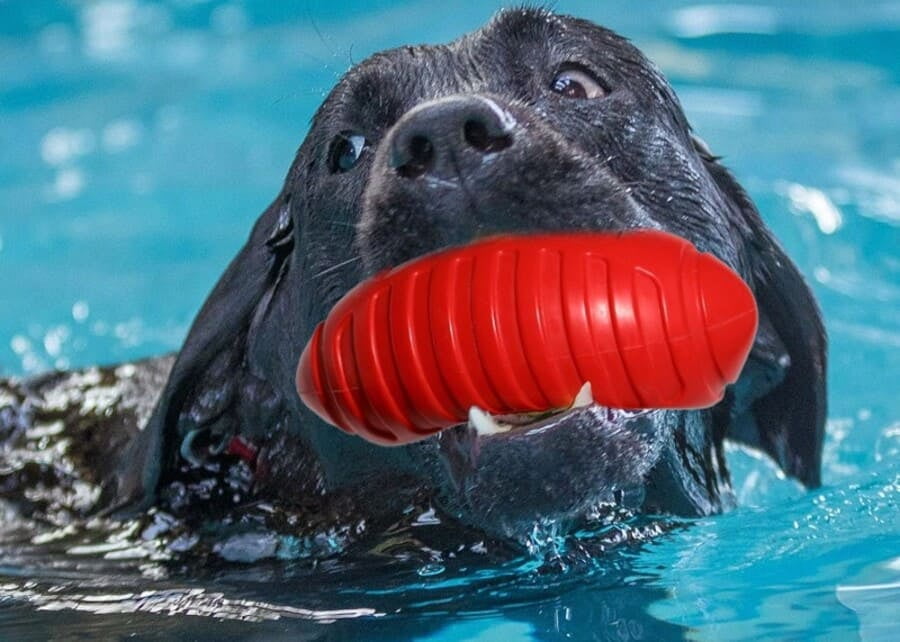
When brand owners come to me with a new dog water toy idea, they’re excited about the design. I immediately steer the conversation to the material. That single choice is what truly defines whether they’ll have a high-volume seller or a high-margin premium product.
The best material for a dog water toy is not a single choice. It’s a strategic decision based on your target market, desired product performance, brand identity, and profit goals. Materials like rubber, foam, TPE, and nylon fabrics each offer unique advantages for different business objectives.
I’ve spent over a decade in pet toy manufacturing, and I’ve seen (brand owners) wrestle with this question countless times. They have a great idea for a floating toy, but get stuck in a sea of material samples. They wonder which one will actually float, which will survive a German Shepherd’s jaw, and most importantly, which one will actually make them money. It’s a decision that feels technical, but it’s deeply tied to your business success.
This article is the manufacturer’s internal guide I wish I could give to every client. We’re going to pull back the curtain and look at these materials not just for what they are, but for what they can do for your brand. We’ll break down the manufacturing realities, the cost implications, and the market opportunities for each option. By the end, you’ll be able to choose your material with the confidence of a seasoned product developer.
What Are the Main Categories of Dog Water Toys from a Manufacturing Perspective?
Thinking about launching a water toy? It’s not just about making something that floats. You need to decide which market segment you’re targeting to maximize your success.
From a manufacturer’s view, dog water toys fall into four main categories: Retrieving Toys (high-volume), Floating & Chewing Toys (high-profit), Interactive & Training Toys (niche), and Cooling & Sprinkler Toys (high-innovation). Each category serves a different play style and business strategy.
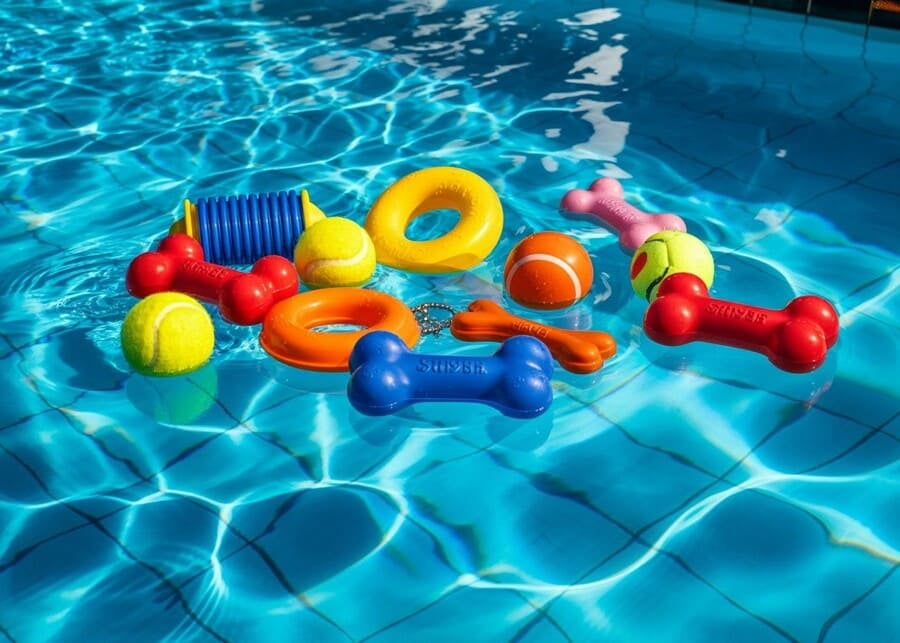
Before we dive into specific materials, it’s crucial to understand the product landscape. As a manufacturer, we don’t just see toys; we see product lines strategies and market opportunities. The type of toy you want to create dictates the materials you can use and the market you’ll compete in. Let’s break down these categories from our perspective, so you can see where your idea fits and how to make it stand out.
1. Retrieving Toys (The "Traffic Drivers")
These are the classic "throw and fetch" toys. Think floating balls, frisbees, and bumper sticks. They are the entry point for most customers and the highest-volume category. The competition is fierce, but the demand is constant. The key to success here is differentiation. For example, we often advise clients to use specific colors. Dogs see blue and yellow спектр (spectra) best, so choosing these colors isn’t just for aesthetics; it’s a science-based decision that improves the dog’s play experience and gives your product a real-world advantage. We can also add glow-in-the-dark powder to a rubber ball formula, creating a unique "dusk and dawn" fetch toy.
2. Floating & Chewing Toys (The "Profit Makers")
This category includes toys designed for dogs that like to lounge and gnaw in the water, like floating "alligator" or "starfish" shapes. These are mid-to-high-end products targeting owners who prioritize durability. The main manufacturing challenge here is balancing buoyancy with bite resistance. A solid rubber toy is durable but sinks. This is where our ODM expertise shines. We use techniques like overmolding, where we create a lightweight foam core and then mold a tough, durable TPE skin around it. This creates a premium toy that is both incredibly durable and buoyant, justifying a higher price point.
3. Interactive & Training Toys (The "Niche Experts")
These toys are for serious play, like water tug-of-war ropes or sinking toys for dive training. This is a professional, high-value market. For these products, construction is everything. When we make a water tug toy, the focus is on the joint strength. We use techniques like bartack stitching, the same reinforcement used on seatbelts, to ensure the handles don’t rip off during intense play. The connection points are engineered with internal anchors, not just sewn on, guaranteeing a level of safety and durability that trainers and serious enthusiasts demand.
4. Cooling & Sprinkler Toys (The "Innovators")
This is the highest value-add category, offering the most profit potential. Cooling toys, which can be filled with water and frozen, require a food-grade TPE shell with carefully designed internal channels. Sprinkler toys are even more complex. They aren’t just a single material; they are a complete product assembly. We build these using an ABS plastic body, stainless steel springs, rubber O-rings for sealing, and brass hose connectors. This category showcases our ability to manage complex supply chains and assemble multi-component products, moving beyond simple toys into innovative pet-tech.
Material Deep Dive: A Manufacturer’s Analysis of Your Best Options?
Confused by terms like TPE, ETPU, and vulcanized rubber? You’re not alone. Choosing the right material is the single most important decision you’ll make in product development.
A manufacturer’s analysis reveals that rubber offers durability, foam provides superior buoyancy, fabrics allow for design flexibility, TPE delivers production efficiency, and rope adds interactive elements. The best choice depends entirely on your product’s function, target cost, and brand positioning.

Let’s get into the specifics. As a factory, we work with these materials every single day. We know their strengths, their weaknesses, and their hidden costs. This isn’t just a list of pros and cons. This is our insider’s take on how each material performs in production and in the market, giving you the business insights you need to make a profitable decision.
Rubber
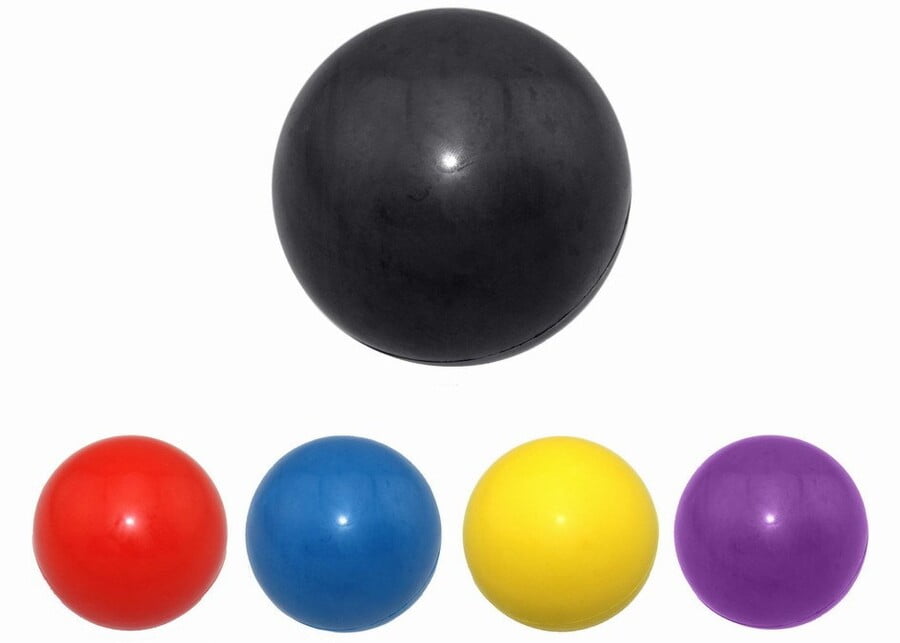
Rubber is the classic choice for a reason: it’s tough, elastic, and easy to clean. But not all rubber is the same, and "it’s made of rubber" isn’t enough information for a business decision.
Business & Manufacturing Insights:
We work with two main types: natural rubber and synthetic rubber (like SBR). Natural rubber is more expensive and highly elastic, perfect for a premium brand. Synthetic rubber offers great abrasion resistance at a lower cost, ideal for mass-market products. The key process is vulcanization, where we heat the rubber with sulfur. By precisely controlling the time and temperature, we can customize the final hardness (measured in Shore A durometer) to your exact specification.
The main upfront cost is the tooling cost for the steel mold. A high-quality steel mold is a significant investment, but it will last for hundreds of thousands of units. For a brand planning a long-term, classic product, it’s a worthwhile expense. If you’re testing a new design, we can explore lower-cost aluminum molds to reduce your initial risk. The challenge with rubber is that most standard formulas sink. Creating a buoyant rubber toy requires a specialized, low-density formula or a hollow design, which adds complexity and cost.
Foam Materials: EVA/ETPU
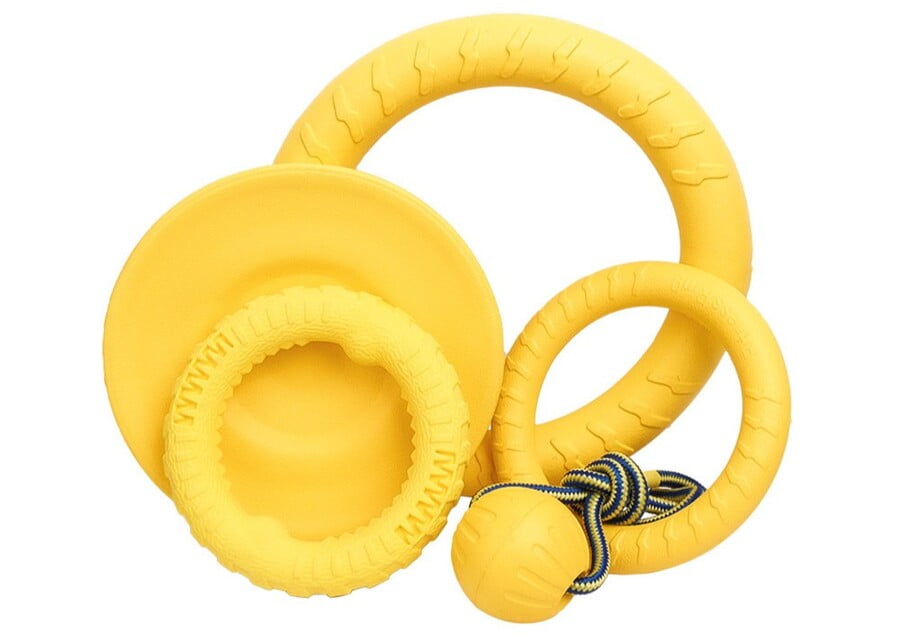
Foam is synonymous with buoyancy. It’s lightweight, colorful, and perfect for water toys. But the difference between basic and advanced foam is huge.
Business & Manufacturing Insights:
EVA (Ethylene Vinyl Acetate) is the entry-level choice. It’s a closed-cell foam, meaning it won’t absorb water. It’s extremely low-cost and can be injection-molded or compression-molded into bright, fun shapes. It’s perfect for price-sensitive, entry-level toys, but its bite resistance is only average.
Our "secret weapon" is ETPU (Expanded Thermoplastic Polyurethane). You might know it as the "popcorn" or "Boost" material in high-end running shoes. It has phenomenal rebound and tear resistance, far superior to EVA. While the raw material成本 (cost) is higher, it allows us to create an ultra-durable, premium floating toy that can command a much higher retail price. For a brand that wants to build a reputation on "indestructible" quality, ETPU is a game-changer that gives you a technical edge over competitors.
Nylon/Canvas/Oxford Cloth
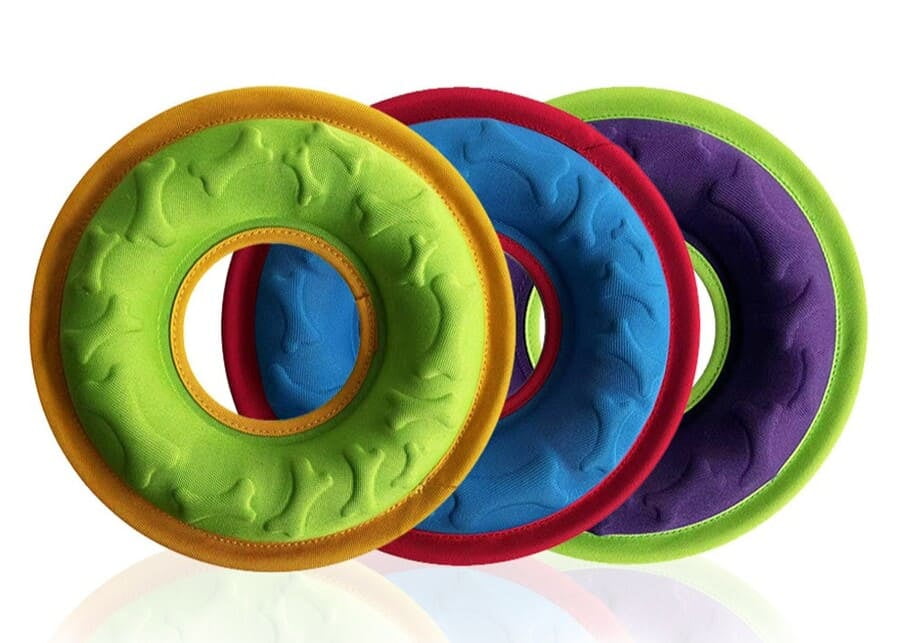
Fabric toys offer incredible design flexibility. They are soft, lightweight, and can be made into complex shapes without expensive molds.
Business & Manufacturing Insights:
We don’t just say "nylon." We talk in specifics. We’ll recommend a 600D (Denier) or higher Oxford cloth or even 1680D ballistic nylon for maximum durability. We then add a PU (polyurethane) coating to make it water-resistant and easier to clean. The real manufacturing magic is in the stitching. We use double-needle seams and X-box stitching at stress points to multiply the toy’s resistance to tearing.
The biggest business advantage here is the low barrier to entry. Fabric toys don’t require expensive molds. This means a much lower MOQ (Minimum Order Quantity) and faster prototyping. This is the perfect route for a startup brand wanting to launch a wide variety of designs quickly or test the market with a limited run. The trade-off is that they are not as durable against heavy chewers and can get dirty.
TPE / TPR
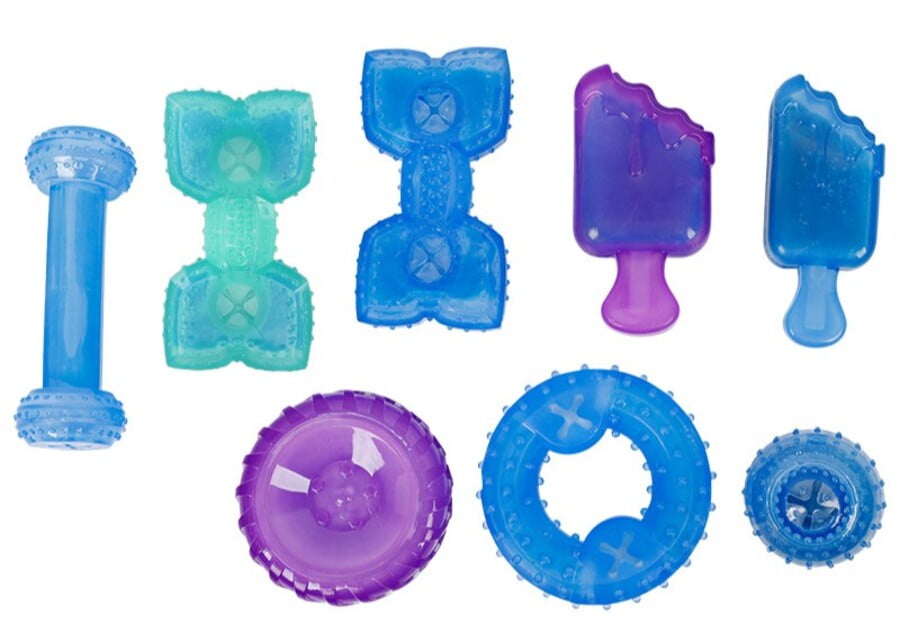
TPE (Thermoplastic Elastomer) and TPR (Thermoplastic Rubber) are fantastic, versatile materials. They feel rubbery but are processed like plastic.
Business &Manufacturing Insights:
We call TPE the "efficiency king." It’s processed through injection molding, which is extremely fast and automated, leading to a lower per-unit cost on large runs. Better yet, any scrap материали (materials) can be reground and reused, which reduces waste and cost, aligning with eco-friendly brand values.
Its biggest strength is customizability. We can adjust the formula to hit a precise Shore hardness, creating anything from a soft, squishy toy to a firm, tough chewer. We can also match any Pantone color, ensuring perfect brand consistency. Many TPE formulas naturally float, making them an excellent, cost-effective "all-rounder" for a wide range of floating toy designs. It’s the go-to material for achieving a specific feel and color with high production efficiency.
Rope

Rope is rarely a standalone material in water toys but is a crucial component for adding interactive play like tugging and throwing.
Business & Manufacturing Insights:
The material choice here is critical and non-negotiable. We will only use Polypropylene (PP) rope for water toys. Its density is less than water, so it floats. It also doesn’t absorb water, so it won’t get heavy, waterlogged, or become a breeding ground for bacteria.
We actively advise clients against using cotton rope. We’ve seen the problems firsthand. Cotton absorbs water, sinks, and becomes a mildew-filled mess. Worse, if a dog ingests shredded cotton fibers, it can cause a life-threatening intestinal blockage. As a responsible manufacturing partner, we see it as our duty to prevent this. We ensure our PP ropes are securely attached and the ends are heat-sealed to prevent fraying, passing rigorous pull-force tests to guarantee safety.
What Should I Consider When Choosing Materials Before Design and Production?
You’ve seen the materials, but how do you make the final call? Choosing a material isn’t a technical exam; it’s a business strategy session with yourself.
Before production, you must consider how your material choice aligns with your target audience, impacts your profit margin, reflects your brand identity, and complies with global safety standards. These four pillars will guide you to a commercially successful product.
This is the part of the process where we move from "what can we make?" to "what should we make?". As your manufacturing partner, our job is to help you think through these critical business questions. A great product idea can fail if it’s made with a material that doesn’t match the customer, the price point, or the brand. Let’s walk through the framework we use with our most successful clients.
Aligning Material with Your Target Audience
Who are you selling to? The answer dictates your material choice. Let’s imagine two of my clients. First, there’s "Sophie," who runs a boutique online pet store. Her customers are brand-loyal, appreciate eco-conscious design, and are willing to pay a premium for quality. For her, we’d recommend a toy made from natural rubber or a premium, overmolded TPE. These materials support a higher price and quality and safety.
Then there’s "David," a purchasing manager for a large online retailer. His goal is volume. He needs a proven, best-selling design at a competitive price point. For David, we’d focus on EVA foam or a simple TPE injection-molded toy. These materials are cost-effective to produce in massive quantities, allowing him to hit the sharp price points his mass-market audience expects. The "best" material is completely different for Sophie and David.
How Material Choice Directly Impacts Your Profit Margin
Every material has a different cost structure. You need to understand this to price your product profitably. Here’s a simplified manufacturer’s formula:
| Cost Component | Description | Example |
|---|---|---|
| Material Cost | The price per kilogram of the raw material. | ETPU is significantly more expensive than EVA. |
| Processing Cost | The cost of labor and machine time to make the toy. | Injection molding (TPE) is faster and cheaper per unit than multi-step fabric sewing. |
| Tooling Amortization | The upfront cost of a mold, spread across the production run. | A $5,000 mold for a 50,000-unit run adds $0.10 to each toy’s cost. |
A fabric toy might have a higher per-unit processing cost due to manual sewing, but it has zero tooling cost, making it great for a small first run. A rubber toy has a high initial tooling cost, but the per-unit cost инфекция (becomes) very low on a large order. We help you model these costs so you can see how your material choice, order quantity, and target retail price all fit together.
Does the Material Reflect Your Brand’s Identity?
Your product is a physical representation of your brand. The material must tell the right story.
- Eco-Friendly Brand? We can source recycled TPE or use natural rubber. The material itself becomes a marketing point.
- "Indestructible" Brand? You need to back that claim up. We’d steer you toward high-density, vulcanized rubber or ballistic nylon with reinforced stitching.
- Playful & Colorful Brand? EVA and TPE are perfect. They come in vibrant colors and can be molded into fun, whimsical shapes that pop on a retail shelf.
The tactile feel of the material, its weight, and its color are all part of the customer’s brand experience. We work with you to ensure the final product feels exactly like your brand.
This is the most critical, and often overlooked, consideration. A product that isn’t compliant is a product you can’t sell, period. As your manufacturing partner, this is our responsibility to manage. The main standards we navigate are:
- USA: The CPSIA (Consumer Product Safety Improvement Act) has strict limits on lead and phthalates.
- EU: REACH regulations control thousands of chemicals, and the EN71 standard governs toy safety (both physical and chemical).
We ensure that the raw materials we source are already certified by our suppliers to meet these standards. We don’t just take their word for it; we maintain our own testing protocols. This isn’t just about ticking a box; it’s about protecting your business from recalls, legal issues, and reputational damage. Choosing a compliant material is the foundation of a sustainable business.
Partner with Preeminent: Your One-Stop Solution from Material to Market?
Feeling more confident, but still see the complexity? From material science to global regulations, creating a successful product is a complex system. That’s where we come in.
At Preeminent, we transform your product idea into a market-ready success. We are not just a factory; we are your strategic partner, guiding you from material selection and ODM design to quality control and global logistics.
We’ve spent this entire article sharing our internal process, showing you how we think. We believe that empowering you with knowledge is the best way to build a successful partnership. Our value isn’t just in making the toys; it’s in the expertise we provide at every step.
For innovators like "Sophie" with a unique vision, our ODM team will collaborate with you to turn cutting-edge materials like ETPU into a signature product that defines her brand. We handle the technical challenges of balancing buoyancy and durability so she can focus on marketing her premium toy.
For large-scale buyers like "David," our one-stop sourcing service is the solution. He can send us a list of 20 different items, and our supply chain team will consolidate them. We ensure that every item, whether it’s a rubber ball or a nylon frisbee, has been vetted for material quality and safety, and we optimize the final shipment to save him thousands in logistics costs.
This is what we do every day. We help brands navigate the complexities of manufacturing to achieve their business goals.
Conclusion
Choosing the right material is the first step to a successful product. It’s a strategic decision that balances cost, performance, and brand identity. We’re here to help you make it.