
I see this constantly in my inbox: you have a killer idea for a new plush dog toy, maybe even a stunning AI-generated image, but you are stuck. You don’t know how to bring it to life and onto a shelf. For many buyers, the manufacturing process in China feels like a black box, and the fear of the unknown—quality issues, delays, or miscommunication—stops great projects before they even start.
We are here to turn the lights on. Understanding the production workflow isn’t just about manufacturing; it is about building the trust you need to sleep at night and the knowledge to plan your market launch accurately. From a rough sketch to a finished, bite-resistant product, we handle the entire "industrial realization" for you. Here is the reality of how we do it in 11 standard steps.
Step 1: Concept Input
We act as your internal design team, which means we don’t put up barriers on how you share your ideas. I know you might not be a professional toy designer, and that is perfectly fine. We just need a starting point to get the ball rolling.
We offer complete flexibility regarding input formats. Instead of requiring finalized engineering drawings, we specialize in interpreting rough concepts—whether they are AI-generated images, physical samples of competitors, or simple napkins sketches—and handling the "industrial realization" so you don’t have to hire external designers.

From Abstract Art to Industrial Logic
Our core value is simple: you provide the "inspiration," and we handle the "physics." We categorize inputs into four types, each requiring a different approach:
- Professional Tech Packs: Ideal for mature brands. We follow your specifications down to the millimeter.
- AI Generated Images: This is the new standard. We are experts at interpreting concept art from Midjourney or ChatGPT. AI often creates "impossible" structures; our job is to translate those pixels into a plush structure that follows physical logic.
- Physical Samples: Send us a competitor’s product. We perform Reverse Engineering, taking it apart to upgrade materials or durability.
- Rough Sketches: Even a simple hand-drawn doodle is enough.
Case in point: We recently worked with "Liam," a brand owner who had a wild AI image of a "Cyberpunk Kangaroo." The AI design had a tail that was too thin to support the body. We didn’t just reject it; we adjusted the tail’s base thickness in the pattern design to ensure the toy could sit upright on a shelf, turning a digital fantasy into a physical reality without losing the look.
Step 2: Feasibility & Blueprint
A factory that just says "yes" to everything is dangerous. You need a partner who will tell you the truth about what works and what doesn’t. We adopt a "Consultant" mindset, conducting a thorough review before we cut a single piece of fabric.
We perform a detailed Design for Manufacturing (DFM) review to generate a comprehensive Production Blueprint. This stage is dedicated to risk prevention: we audit your design for safety compliance (ASTM F963/EN71) and optimize the pattern layout to reduce material waste, directly lowering your unit costs.

The Consultant Mindset in Action
- Cost Optimization: We analyze how the toy’s pattern fits onto a standard fabric roll. I remember a project where simply shortening a fox’s tail by 2cm allowed us to fit 20% more pieces onto a standard fabric roll. That small tweak saved the client a huge amount on raw material costs without changing the consumer’s perception.
- Safety Audit: We look for structural weaknesses. If a design has long, spindly legs, we know a dog will rip them off instantly. We will suggest widening the connection points or adding internal nylon reinforcement to ensure durability.
- Technical Output: The result is a comprehensive Production Blueprint. It specifies not just dimensions, but the exact location of the squeaker (to protect it), internal lining specs, and seam positions, eliminating ambiguity for the production line.
Step 3: Confirmation
Before we move to the expensive stage of sampling, we must align perfectly on the sensory details. Misunderstanding "softness," "size," or "craftsmanship" here leads to frustrating revisions later.
We eliminate assumptions by confirming every variable before production. This involves digital approval of fabric textures, defining precise measurement standards (e.g., sitting height vs. full length), selecting sound profiles, and finalizing craftsmanship details (embroidery vs. printing) and auxiliary material specifications to match your target audience.
Locking Down the Details
"Blue" is not a color, and "Soft" is not a texture—we need specifics to ensure the sample is right the first time.
- Fabric Texture Approval: We don’t guess. We send high-definition photos or videos of the fabric swatches so you can check the Pile Height (fur length), Texture, and GSM (weight). You need to "see" the hand-feel through the screen.
- Defining Dimensions: We clarify how we measure. If you ask for a 30cm toy, does that include the tail? We distinguish between "Sitting Height" and "Head-to-Tail Length" to avoid the disappointment of a toy looking smaller than expected.
- Internal Components: We match the sound to the toy. Do you want a high-pitched squeak, a low-tone grunt, or crinkle paper? We also match the squeaker size (25mm, 35mm, 50mm) to the toy’s cavity to ensure it’s loud enough but not bulky.
- Craftsmanship Definition: We decide the method for expressions and logos upfront. We help you choose between Embroidery (safer and more bite-resistant) or Printing (better for complex details). Locking this down now prevents directional errors during sampling.
- Auxiliary Materials: If your design includes mixed materials, we specify the exact specs. For ropes, we confirm diameter (Dia) and material (Cotton vs. Poly-cotton). For TPR/Rubber parts, we verify the hardness and certify that materials are non-toxic.
Step 4: Sample Creation
This is the magic moment where 2D concepts transform into 3D reality. It requires highly skilled labor and engineering, not just simple sewing.
Our senior pattern makers break down the design into paper patterns, select the closest stock materials, and hand-sew the initial prototype. While there is a sample fee ($100-$200), it covers 3-5 hours of expert engineering and is fully refundable once your bulk order meets our MOQ.

The Value of a Pattern Maker
Many clients ask why a sample costs $150 when the toy costs $5. The answer lies in the Pattern Maker’s time. Converting a drawing into a 3D plush requires spatial geometry skills. A senior pattern maker spends hours drafting paper patterns, cutting trial pieces, sewing, rejecting the shape, adjusting the curve by millimeters, and sewing again.
The Good News: We view the sample fee as a deposit of good faith. Once you place a bulk order (e.g., 2000pcs), this fee is credited back to you. This lowers the psychological barrier to entry while ensuring we dedicate our best resources to your project.
Step 5: Sample Review & Approval
You cannot sign off on a product you haven’t inspected thoroughly. We provide a structured, multi-stage review process to ensure the sample meets your standards before it becomes the benchmark for mass production.
We execute a strict three-phase approval process: a digital Visual Check to verify details, a Physical Check via express delivery for hands-on approval, and finally, the establishment of the "Golden Sample." This ensures that the prototype you hold in your hand becomes the exact, unchangeable standard for the entire production run.
Three Stages of Confirmation
We don’t want you to waste money shipping a sample that has obvious errors. We follow this strict sequence:
- Visual Check: Before shipping, we send you High-Res Photos (standard 3-view: front, side, back) and a Video Walkthrough. In the video, we demonstrate the tactile elements: we squeeze the toy to show the "hand feel," press the squeaker to prove the sound quality, and pull hard on the seams to demonstrate durability.
- Physical Check: Only after you confirm the video and photos look correct do we ship the physical sample via DHL/FedEx. This saves time and shipping costs by ensuring the sample is 99% right before it leaves the factory.
- Golden Sample: Once you receive the sample and are satisfied, you sign off on it. This signed sample becomes the "Sealed Sample" (Golden Sample). We keep a duplicate at the factory, and it serves as the absolute standard for mass production. If a worker on the line is unsure about the stuffing level, they don’t guess—they consult the Golden Sample.
Step 6: Material Preparation & Cutting
Once the Golden Sample is confirmed, we officially launch the bulk fabric procurement. Durability starts here, not on the sewing line. We implement strict protocols to ensure the material itself is stable, consistent, and prepped for heavy-duty use.
We enforce a rigorous workflow starting with Incoming Quality Control (IQC), where fabric must pass a "Relaxation" period and a lightbox color check against the Golden Sample. We then utilize Laser Cutting technology exclusively. This not only guarantees 0.1mm precision for standardization but also cauterizes the fabric edges, creating a sealed border that significantly enhances seam strength.

Incoming Quality Control (IQC)
We don’t just buy fabric and immediately cut it. We treat the raw material first.
- The "Relaxation" Rule: Fabric rolls arrive stretched from the tension of transport. If cut immediately, the parts will shrink later, causing deformation. We force a 24-hour Relaxation Period where the fabric is unrolled to "breathe" and return to its natural state before cutting.
- Color & Defect Check: We inspect the fabric under a standard lightbox, comparing it strictly against the Golden Sample to ensure there is no "dye lot difference" (color variation). We also scan for runs or physical defects. Only 100% qualified material enters the production line.
Laser Cutting: The Foundation of Durability
Why do we choose Laser Cutting over traditional Knife (Die) Cutting? It comes down to physics.
- The "Cauterization" Effect: Knife cutting leaves raw, fraying edges. Laser cutting uses high heat to slice through the synthetic plush, instantly melting and sealing (cauterizing) the edge.
- Durability Benefit: This hardened, sealed edge acts like a physical "lock." When we sew the pieces together later, the thread has a solid foundation to grip onto. This is the critical physical basis that prevents "seam bursting" when a dog plays rough.
Precision & Consistency
Laser cutting is digital; knife cutting is manual. Our laser machines read directly from the CAD blueprints with a precision of 0.1mm. This guarantees absolute standardization—meaning the 1st toy and the 10,000th toy in your order have the exact same panel shapes, ensuring consistent assembly quality across the entire batch.
Step 7: Embroidery & Printing
Aesthetics matter, but safety matters more. We perform all decorative processes on Flat Panels—meaning the fabric pieces are embroidered or printed before any sewing begins. This ensures that the alignment is precise, the pattern is flat, and the expression is lively.
We offer two primary decoration methods based on your design needs. For facial features and logos, we strongly advocate for Electronic Embroidery due to its superior safety and bite resistance. For complex gradients or full-body patterns, we utilize Eco-friendly Heat Transfer or Digital Printing.

Electronic Embroidery (Recommended for Pet Toys)
For dog toys, we almost always recommend embroidery over other methods for eyes, noses, and brand logos.
- Process Detail: We use High-density stitching. This creates a tight, solid block of thread that is incredibly durable.
- Safety Advantage: Unlike plastic "safety eyes" (which have a backing washer but can still be cracked or pulled out by a determined chewer), embroidery is integrated into the fabric itself. It cannot be bitten off or swallowed.
- Durability Advantage: Compared to surface printing, embroidery won’t fade or peel off after repeated chewing and washing. It is the gold standard for high-quality pet products.
Heat Transfer / Digital Printing
Sometimes, a design calls for more than just solid colors—think tie-dye, complex gradients, or tiny text instructions.
- When to use it: We use Heat Transfer or Digital Printing for designs with Gradients or for All-over patterns (customizing the entire fabric roll with your design).
- Process Detail: The ink penetrates deep into the fabric fibers rather than just sitting on top like a sticker. This ensures high color fidelity.
- Safety Commitment: We strictly use Non-toxic, Eco-friendly inks. We know dogs lick their toys, so we ensure that the chemical safety of the ink meets the same standards as the fabric itself.
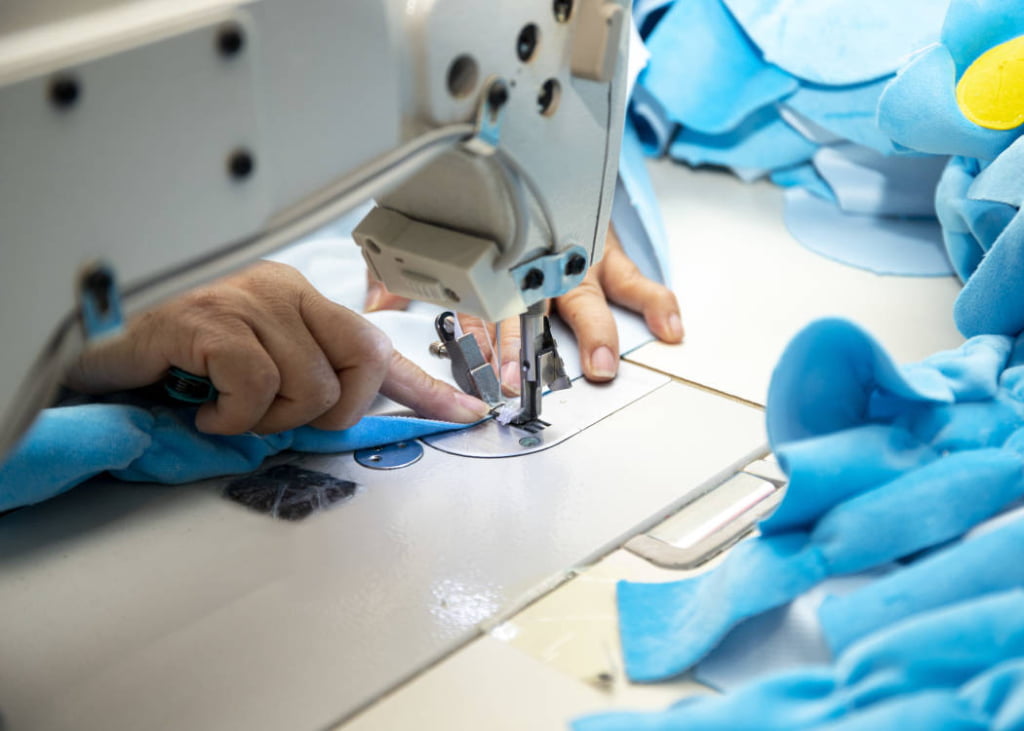
Step 8: Sewing & Reinforcement
This is the assembly phase where the toy takes shape. Unlike standard plush toys for humans, dog toys require specialized construction techniques to withstand abuse.
We utilize "Reinforced Stitching" as a standard for pet products. This includes adding a layer of Mesh Lining (chew guard) behind the fabric and using Double Stitching on high-stress areas like limbs and ears to create a robust "shell" that resists tearing.
Building the "Shell"
If you cut open a cheap dog toy, you see one layer of fabric. If you cut open our toys, you see a sandwich structure.
- Mesh Lining: We laminate a tough mesh net behind the soft outer fabric. Even if a dog’s tooth punctures the fur, it gets caught in the mesh, preventing the hole from expanding.
- Double Stitching: On parts that stick out—ears, tails, legs—we run the sewing machine twice. The first line holds the shape; the second line is the backup. This redundancy is essential for customer satisfaction and reducing returns.
Step 9: Stuffing & Closing
A toy’s "feel" and safety depend entirely on what’s inside and how it’s sealed. We have strict protocols to ensure consistency and safety in the filling process, treating it as a precise science rather than a manual chore.
We adhere to a four-point filling standard: using exclusively 100% New PP Cotton for superior resilience, centrally wrapping squeakers to prevent punctures, maintaining strict weight tolerances (±5g) for consistency, and sealing every toy with a hand-sewn "Ladder Stitch" that is both invisible and secure.
Material Quality: 100% New PP Cotton
We make a solemn promise: we use 100% New High-Elasticity PP Cotton. We absolutely refuse to use "black heart cotton" (dirty, recycled industrial waste).
- Why it matters: High-quality new cotton has superior memory. It allows the toy to bounce back instantly after being squeezed, crushed, or chewed, maintaining its shape over time.
Squeaker Placement: The Core Protection
The number one complaint in toy reviews is "The squeaker broke in 5 minutes." This happens when the squeaker is placed right against the fabric.
- Our Solution: Workers wrap the squeaker in a thick ball of cotton before inserting it into the toy, positioning it in the dead center.
- Benefit: This cotton buffer acts as a shock absorber. When the dog bites, they compress the cotton, not the plastic squeaker directly, significantly extending the toy’s lifespan.
Weight Consistency: The ±5g Standard
We don’t rely on "feeling." Every single toy goes on a digital scale.
- The Standard: We set a strict tolerance (e.g., ±5g). This ensures that whether you pick up the 1st toy or the 10,000th toy from the shipping container, their fullness, density, and hand-feel are exactly the same.
Hand Stitching: The Invisible Seal
The final closure is done by hand, not a machine. Our skilled workers use the Ladder Stitch (Invisible Stitch) to seal the stuffing port.
- Technique: This stitch folds the raw edges inward and pulls them tight, making the seam flat and nearly invisible.
- Result: It prevents dogs from finding a loose thread to pull at. We also carefully control the stuffing volume to ensure the toy is plump and full, but not rock hard, protecting the dog’s teeth while satisfying their chewing instinct.
Step 10: Shaping & Inspection
This step is the defining line between a high-end brand product and a cheap stall item. A toy fresh off the stuffing line is often stiff and distorted. We treat this finishing stage as an art form, ensuring every product has "personality" and meets strict safety standards.
We perform a four-step finishing process that transforms a semi-finished product into a premium toy. This includes a manual "Massage" to correct symmetry ("Injecting Soul"), "Seam Grooming" to hide stitching lines, rigorous "Thread Trimming" for a clean finish, and a mandatory pass through an industrial Metal Detector.
The "Massage": Injecting the Soul
- Reality: A toy that has just been filled with cotton is often stiff, uneven, and lifeless.
- Action: Our finishing team performs a professional "Massage" on every single unit. Through kneading and patting, they push the internal cotton into the tips of the limbs and corners, eliminating lumps and ensuring an even hand-feel.
- Symmetry Check: We focus intensely on the head and face. We adjust the eyes to be perfectly horizontal and ensure the nose is centered. We have zero tolerance for "crooked face" toys, as we know facial asymmetry directly kills a consumer’s desire to buy.
Seam Grooming: The High-End Detail
- The Problem: During sewing, long plush fur often gets pressed into the stitch line, creating unsightly "bald spots" or visible lines.
- The Process: Workers use steel needles or brushes to pick out the trapped fur (Picking out trapped fur) one by one.
- The Result: This makes the seams almost invisible. The toy looks like it is made from one continuous piece of fabric rather than patched together—a detail that high-end brands appreciate most.
Thread Trimming & Visual Check
- The "Clean Finish" Rule: We have a dedicated trimming station where workers inspect and snip off all excess thread ends.
- Why it Matters:
- Aesthetics: A product without messy loose threads looks refined and premium.
- Safety: Dogs are naturally curious about loose strings. Removing them prevents a dog from pulling on a thread, unraveling the seam, and destroying the toy’s structural integrity.
Metal Detection: The Final Defense
- Non-negotiable: Before packaging, 100% of our products must pass through an industrial-grade Needle Detector.
- The Promise: Needles can break during high-speed sewing. This step is our absolute commitment to pet safety, ensuring that no broken needles or metal fragments are ever left inside a toy sent to your customers.
Step 11: Packaging & Logistics
The final step is ensuring the product arrives at your warehouse in the same pristine condition it left ours, while also minimizing freight costs. We focus on protecting the structural integrity of the toy while offering a wide range of retail-ready presentation options.
We generally enforce a strict "No Vacuum Packing" policy to protect squeakers and shape, except for super-large plush items. We also provide fully customized packaging solutions, including OPP bags, zipper bags, drawstring bags, header cards, and color boxes, ensuring your product looks premium the moment it is unpacked.
The "No Vacuum Packing" Principle
While vacuum packing reduces shipping volume, it is often a death sentence for high-quality squeaker toys.
- Protecting the Core: Vacuum packing sucks the air out with such force that it can crush plastic squeakers and permanently destroy the "memory" of the PP cotton, leaving the toy looking flat and lifeless on the shelf.
- The Exception: We strictly advise against vacuum packing for standard toys. The only exception is for Super Large Plush Dog Toys (e.g., giant beds or oversized animals) where the freight savings are massive and squeakers are less prone to damage due to deep layering. For everything else, we use "Micro-Compression" to save space without damaging the product.
Custom Packaging Options
Packaging is your brand’s first impression. We offer diverse options to fit your budget and retail channel:
- Basic Protection: Standard OPP Bags for cost-effective bulk shipping.
- Premium Reuse: Zipper Bags or Drawstring Bags (Canvas/Nylon) that add value and can be reused by the customer.
- Retail Hanging: Header Cards (cardboard tops) or Hang Tags for supermarket and pet store shelves.
- Gifting: Color Boxes or Display Boxes (PDQ) for high-end gift sets or holiday promotions.
Conclusion
From the moment you send us an idea to the moment the final metal detector beeps, this 11-step process is built on a foundation of safety, durability, and consistency. We handle the technical headaches so you can focus on building your brand.
Have an AI image or a rough sketch? Send it to us, and let’s start Step 1 today.
If you want to understand the broader picture of how we can help your brand grow, read our comprehensive guide: The Ultimate Guide to Custom Plush Dog Toys: From Concept Design to Mass Production.