
We have all seen the angry reviews. A customer buys a "tough" plush dog toy, and ten minutes later, their living room looks like a snowstorm of white stuffing. It is frustrating for the owner, and it is a disaster for your brand reputation.
To manufacture a truly heavy-duty plush dog toy, you must move beyond standard sewing methods. It requires specific manufacturing protocols: thermal lamination of power mesh liners (Chew Guard technology), high-density double stitching (10-12 SPI), and reinforced edging to protect weak points from aggressive chewers.
Many brands think adding a "Tough" sticker to the packaging is enough. It is not. If you want to build a product that actually lasts, you need to understand exactly how we build them on the factory floor. Let’s break down the technical specs that separate a cheap toy from a heavy-duty contender.
The "5-Minute" Problem
Does your brand promise "indestructible" plush dog toys, only to deal with a flood of returns and complaints when a determined Pitbull destroys them in minutes? This disconnect breaks trust.
There is no such thing as a truly "indestructible" plush toy, and admitting this is the first step to quality. However, by analyzing exactly how materials fail under stress, we can manufacture "long-lasting" products that offer high value and survive weeks, not minutes.

At Preeminent, we believe in honesty with our clients. When a new brand owner comes to us asking for a soft toy that can never be destroyed, we have to talk about physics. If a dog has enough time and intent, soft fabric will eventually tear. The goal of manufacturing heavy-duty toys is not magic; it is extending the "time-to-destruction."
We need to look at where the failures happen. Usually, it is not the fabric tearing in the middle. It is a tooth puncture that grows, or a seam that pops under tension.
I remember a project we did for a client in the UK. They wanted a standard plush fabric but marketed it for power chewers. We warned them that without internal reinforcement, the return rate would be high. They launched anyway to save on cost. Two months later, they came back to us to re-engineer the entire line because the market backlash was severe. We moved them from a standard construction to a reinforced "tough" spec. The lesson is simple: you cannot trick the dog. We have to build a technical barrier between the dog’s teeth and the toy’s integrity.
Structural Reinforcement
Why does a thick fabric still rip easily when a dog shakes it violently? The answer often lies in the lack of support layers and weak edge protection.
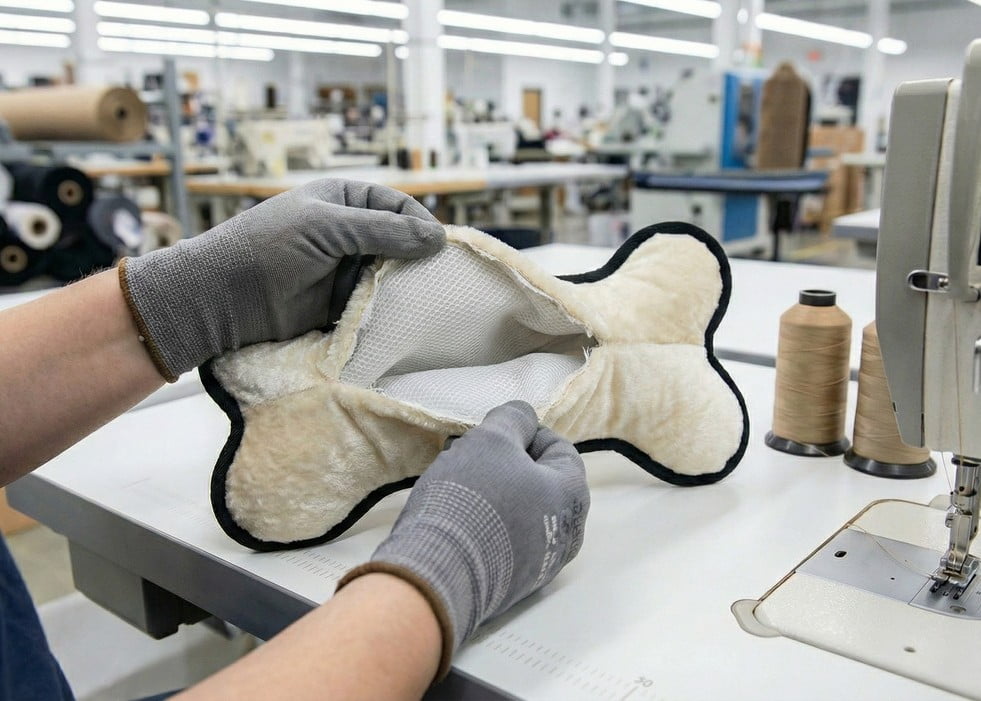
Structural reinforcement is the core of a heavy-duty toy. This involves Thermal Lamination to bond a "Power Mesh" liner directly to the plush fabric, and using specialized edging to armor the seams against being used as entry points.
This is where the real manufacturing difference happens. In a cheap toy, you have the outer fabric and the stuffing. In our heavy-duty lines, we add critical steps to reinforce the structure.
Mesh/Nylon Liner:
We take a layer of high-strength Power Mesh—think of it like a flexible cage—and use heat to bond it permanently to the back of the soft outer fabric. This is often marketed as "Chew Guard Technology." When a dog’s tooth punctures the soft outer fur, it hits this mesh barrier. The mesh stops the hole from expanding. Without this lamination, a single puncture becomes a large rip in seconds.
Reinforced Edging:
Next, we look at the edges. A dog is smart. They will find the edge of a toy and pick at it with their front teeth. To stop this, we use reinforced edging. We wrap the vulnerable seams in robust, heavy-duty fabrics—such as high-grade nylon, thick canvas, or other abrasion-resistant textiles suited to the specific product design. This creates a "bumper" that protects the structural seam underneath.
Implementing this at the factory level is not easy.
- Material Cost: This adds about 15-20% to the raw material cost.
- Production Time: The material is now very thick. Our sewing operators have to slow down. We cannot run the machines at high speed, or needles will break.
- Skill Level: It takes a skilled worker to sew through three layers (Plush + Mesh + Edging) cleanly.
But for a toy that retails over $15, this investment is mandatory. It turns a piece of fabric into a composite shield.
Seam Strength
You have reinforced the fabric, but why does the toy still pop open? The strength of the fabric means nothing if the thread snaps or the seam unravels.
Seam strength is determined by the Stitch per Inch (SPI) count and the physical design of the seam. We utilize double stitching with a density of 10-12 SPI and "Hidden Seams" (inverted construction) to prevent dogs from finding a leverage point.
When we set up the production line for heavy-duty toys, we change the machine settings completely. It is not just about sewing; it is about engineering the hold.
Double Stitching (High SPI):
Standard toys usually get a single pass with a standard density. We run the seam twice. But the real secret is the SPI (Stitches Per Inch).
- Standard Toy: 7-8 SPI. This is fast and uses less thread.
- Heavy-Duty Toy: 10-12 SPI.
Why does this matter? Imagine a 70lb Golden Retriever playing tug-of-war. The instant pull force is massive. If the stitches are too far apart (low SPI), the thread bears too much load per inch and snaps. With a higher SPI, that load is distributed across more stitches, preventing the toy from bursting open.
Hidden (Inverted) Seams:
We also utilize Hidden Seams, technically known as Inverted Seams. We design the pattern so that when the toy is turned right-side out, the seam rolls inward. This removes the "lip" of the fabric. If a dog cannot get their teeth under the seam, they cannot use leverage to rip it open. Additionally, we often upgrade the thread itself to bonded nylon, which resists snapping under sudden shock loads much better than standard polyester.
Design for Durability
Why do dogs always chew the ears, tails, and arms off a toy first? It is not a coincidence; it is instinct, and bad design enables it.
Durable design minimizes weak points by reducing appendages. We use "Integrated Structures," where limbs are part of the main body pattern rather than attached pieces, forcing the dog to chew the reinforced main body.
Design is just as important as materials. You can have the strongest fabric in the world, but if you sew a long, thin tail onto the back, it will be ripped off in five minutes. We apply critical thinking based on actual dog behavior.
The Vulnerability of Appendages:
Dogs have a "shake and kill" instinct. They grab the floppy parts—ears, arms, tails—and shake their heads violently. These parts act like levers. The force at the connection point is huge, and standard seams cannot hold up to that torque. If a toy has many long, thin parts, it is essentially designed to fail.
Integrated Structure Solutions:
To solve this, we push for Compact Design or Integrated Structure.
- The Problem: Sewing an arm onto a body creates a weak seam.
- The Solution: Cut the fabric pattern so the arm and body are one continuous piece.
I recall a conversation with a client who wanted a flamingo toy. Originally, they wanted a long, slender neck. We advised them that the neck would be a weak point. We redesigned it to be a "seated" flamingo, where the neck was stitched flat against the body. The toy still looked like a flamingo, but it became a solid block rather than a fragile stick. By removing the appendages, we force the dog to bite the widest part of the toy—the body—which is where our mesh reinforcement and double stitching are strongest.
Conclusion
Manufacturing a heavy-duty dog plush toy is about layering defenses. We combine Thermal Lamination to stop punctures, Reinforced Edging to protect seams, High SPI Double Stitching to resist tearing, and Compact Design to remove weak points. It costs more to build, but it builds a brand that customers trust.
If you are ready to start building your own line of high-quality plush pet toys, check out our core guide: The Ultimate Guide to Custom Plush Dog Toys: From Concept Design to Mass Production .